
Blocks, bolsters, straps – what do I do with these? Do you have some yoga blocks or a strap that you never pick up? Use them! Props are like training wheels in our yoga practice. These simple little gadgets help to make poses more accessible. You don’t have to buy the Gaiam brand at Sports Authority to get the same effect either – you can often just use items in your house as yoga props if you don’t already have them.

So let’s talk about some of the most used props: Blocks, Straps, Blankets, and Bolsters. Yoga wheels are another great prop that I will cover on a separate post.
Blocks are meant to help lift some part of the body. In the pictures below, you can see how blocks help me to elevate some body part, which results in creating more space in the body. If you don’t have yoga blocks, you can use a low table or chair or even some books!
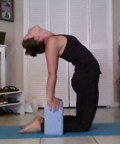 Here in Camel pose, I am using blocks under each hand to help me elevate my chest to the ceiling even more. This extra lift gives me more mobility in my thoracic spine which takes a lot of undue pressure out of my low back. Using blocks in Camel is a great way to modify, or make a pose more accessible, for those of us that have a tight back or can’t reach our ankles yet.
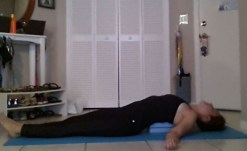 Here I am using the block to support my thoracic spine in Fish pose. Fish pose requires significant mobility in the thoracic and cervical spine. If I don’t have that range of motion, I can use a block under my middle back to help gain the same benefits from this pose. This is a great way to modify Fish and make it into a restorative pose!
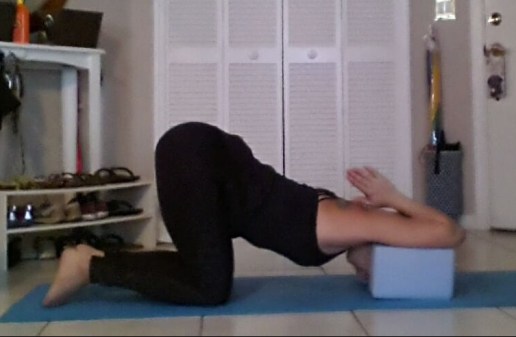 You can also use blocks in Puppy pose to help as a shoulder opener. By placing the blocks under my triceps, I create space between my chest and the mat. Now I can keep pushing my chest to the mat resulting in a deeper shoulder opening pose. Be sure to be kind to your body in these modifications – not pushing yourself too far.
Straps are meant to help you open your upper body, especially your thoracic spine. This prop is often used in backbending postures featured in the pictures below. If you don’t have a yoga strap, you can use a tie, belt, rope, or any length of fabric.
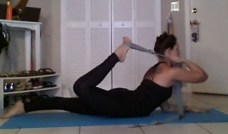 Here I am using the strap in Half Bow to hook my foot and open my thoracic spine a little more. You can also do this same modification in Full Bow. When pulling on the strap, you want to be walking your hands BACK towards the feet, not pulling the foot towards your head. Remember, the strap is meant to help you open, not pull.
 In King Pigeon, straps are a necessity for working towards achieving the full expression of this pose. Once in basic Pigeon pose, you hook the foot in the strap and pull the strap overhead. Keep opening in the middle back, between the shoulder blades, as you walk your hands BACK towards your foot. Whenever you are using a strap, think about squeezing the shoulder blades together, opening the heart.
 Another way to use a strap, is shown here in Gomukasana or Cow-face pose. You start with the strap in your left hand, reaching the left arm up, bend the elbow, and let the strap fall behind the back. Take your right arm out to the side, turn your thumb down, bend the elbow and reach for the strap behind your back. Then, you begin to walk both hands towards each other. Again, thinking about opening the heart, opening the left shoulder, and squeezing the shoulder blades will help you get there.
Blankets are meant to help you create a more comfortable resting spot on the mat. People often use blankets under the knees, hips, or wrists to create a more cushioned surface for practice. You can use any blanket you find in your home.
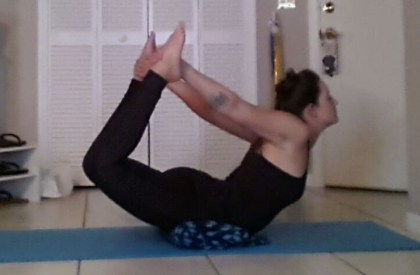 Here in Bow pose, I have a folded blanket under my hips. This gives me more cushion under my hipbones so I don’t feel so uncomfortable achieving this pose.
You can use a blanket in this manner for any pose on the belly, such as Locust, Sphynix, Crocodile, or Half Bow.
 You can use a blanket to support your knees like here in Camel pose. In this pose, the blanket provides needed support for the knee caps.
You can use a blanket in this manner for any pose on the knees, such as Cat/Cow or Puppy.
Another great way use for blankets as a prop is for seated postures. If it is uncomfortable to sit for extended time, you can sit on a folded blanket, which lifts your hips above the knees.
Bolsters are their purpose- cushion! Bolsters are most often used in restorative classes or for resting poses like Savasana. However, they can be used in your regular practice to provide you with more comfort. If you don’t have a bolster, look at your couch. Use one of those gigantic pillows for your back as a bolster or you can use a body pillow folded in half.
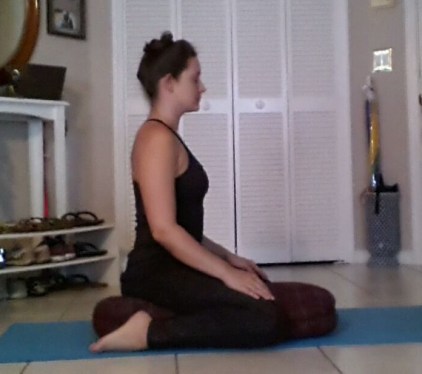 Here I am using a couch cushion (instead of a bolster) to sit on in Virasana or Hero’s pose. Many people experience knee pain when sitting in this pose, so be sure to use a bolster to make it more comfortable.
This is also a great modification for easy seated pose, Sukhasana, if it’s not comfortable for you to have your hips open passively.
 In this picture, I have placed the bolster under my ribs and elbows to help support me in a variation of Cobra. The bolster is providing me with comfort in this pose and is also lifting me (like a block) to help me open my thoracic spine more.
Now that you know what to do with all these yoga props, look around your house and start to use them! When you get into a pose and think, “This doesn’t feel good,” ask yourself why. Identify how you can make it more comfortable, where you need support in the body. Then, find a prop and use it to make your practice safer, healthier, and more accessible.
Have a great Friday! See you next week.
Peace and love,
Melissa
 A Yogi's Mind
1 thought on “Prop Yourself Up”