
What is layering in a yoga practice? Why is it important to layer?

Layering means working into the body slowly and steadily, using different poses in a methodical way in order work deeper into certain parts of the body. Take the arm balance EPK (Eka Pada Koundinyasana), pictured below.
 This is not a pose that yogis just throw themselves into as the first pose in their practice. If you want to achieve an advanced pose, you must LAYER your warm up and Sun Sal practice to activate and open those parts of the body involved in that dream pose!
I am guilty of waking up and trying a crazy arm balance or inversion. But later that day or the next morning I don’t feel as loose and happy in my body. Lesson learned- NEVER skip the warm up! Instead of falling into a boring routine warm up, think about where you want to end up at the end of your practice and USE your warm up to get you there.
In this article, I will describe 5 poses you can incorporate into your warm up that can help you activate your arms, legs, hips, and core. These are the body parts you need to work in order to get you closer to achieving your EPK!

 Trusty ‘ole Cat and Cow is our first warm up! Make sure you warm up your spine and activate those back muscles.
Inhale, arch the back, lift the tailbone and gaze to find Cow pose.
Exhale, rounding the back, tucking the tailbone and chin, pushing the mat away to find Cat pose.
 Come back to neutral, tuck your toes and then step one foot back at a time, pulling into the core finding a Plank pose.
While you’re here, activate your core creating a straight line from the top of your head to your tailbone.
Think about spreading your collarbones wide while at the same time protracting the shoulders, spreading the shoulder blades. These opposing actions will help you maintain a neutral spine in plank and activate the front and back bodies.
Reach the right leg back on an inhale, then exhale rounding the back, bring the right knee out wide toward the tricep and plant the foot on the outside of the right pinky finger.
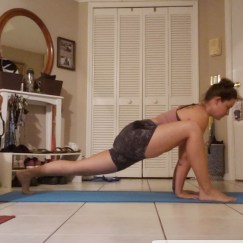 This wide stance prepares you for Lizard pose. In this pose you’re focusing on engaging the legs, pulling the right hip back, lengthening in the left hip flexor. You can stay up on your hands or you can lower to your elbows taking a low lizard. You can keep it active by rocking slightly back and forth and lifting/lowering the hips.
Be sure to repeat on both sides. Stepping the right foot back to plank or downward facing dog and repeat for the left leg.
Come back to downward facing dog or plank. Then bend the right knee and bring it to the right wrist, laying the shin down. Lengthen through the left leg, preparing for Pigeon pose.
 Here in Pigeon keep your body weight centered, not leaning left or right. You can always place a block, bolster, or blanket under your hips if you can’t release to the mat. You can stay upright if that feels good or you can release the upper body forward to find a resting pigeon pose.
Remember to keep the lower leg engaged by pointing through the toes.
Repeat on both sides to get those hips and legs active.
Come back to a plank pose and create that straight spine again, engaging the core, lengthening the collarbones and protracting the shoulders (separating the shoulder blades).
 Maintain that straight spine as you squeeze your elbows together, rocking forward and lowering the chest finding Chaturanga Dandasana.
Try to hold this pose for as long as you can. Chaturanga is the shape your upper body is making in the final pose of EPK so you need to feel very strong here. Maintaining that 90 degree bend in the elbow and continue to squeeze the elbows into your sides.
You can lower all the way to the mat and take a cobra or upward facing dog pose to counter all of that core and arm work. Press back up to downward facing dog and come to another lizard lunge on each leg.
 Come down to a Low Lizard Lunge first, breathing into* the hamstring of the bent leg (right in this picture).
*When you “breathe into” a muscle group or part of the body, you imagine that body part and focus your thoughts on what it feels like there right now in this pose. With every breath, you connect more and more to what you’re feeling there, helping you know whether to back off or go deeper.
Once you’ve worked into the hamstring enough to be comfortable here, you can lift your hips (almost like you’re going to take off in a sprint).
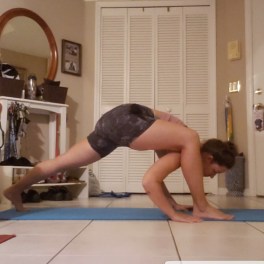 After you get your hips high enough, start to work on getting your shoulder under your thigh. Lowering your chest as much as you can, planting your hands firmly into the mat, preparing for a Chaturanga shape in the arms, squeezing the elbows together.
Shoulder under the thigh, hands planted firm, elbows close to the body, begin to lower the hips. You can rest the thigh on the tricep and begin straightening the right bent knee, reaching forward through the toes. On the left side, you can rest your left hip on your left elbow and squeeze the left glute, reaching up through the left toes.
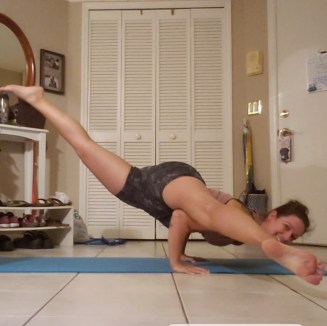 As you squeeze the left glute and reach through both toes, you’ll begin to feel a lightness in the legs and you lift up off the ground to an EPK!
Don’t judge yourself on a first try of a pose. Be kind to your mind and body. Be proud of yourself for trying something new and if you like it, incorporate it into your practice. If you don’t like it, throw it out for now (you might come back to it after a while).
Protect your body by using that warm up to suit your needs and wants. If you want to work up to a difficult pose like EPK, make your warm up serve your body! Keep it fun and fresh, find inspiration from others, ask for advice and stay open. Most importantly respect your body so your practice has longevity.
Have a great Friday! See you next week.
Peace and love,
Melissa
 A Yogi's Mind
Great explanation of layering and the pictures really help illustrate the different poses.
LikeLiked by 1 person